
For most Language Service Providers, the idea of B2C certified translation services has always come with friction.
Low-value jobs. High operational overhead. Endless emails. Minimal margin.
So historically, many LSPs have avoided it altogether or treated it as a necessary distraction from their core B2B work.
That is starting to change.
With AcudocX, a growing number of partners including 2M Language Services and Avantpage are not replacing their B2B model. They are layering a scalable B2C channel on top of it.
This shift is simple in structure, but powerful in impact.
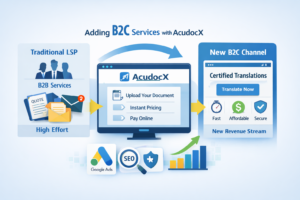
The shift: from service provider to self-service platform
The key insight is this:
Partners are not becoming B2C companies.
They are enabling a self-service B2C experience within their existing business.
Instead of:
-
manual quoting
-
project management overhead
-
fragmented communication
They offer:
-
instant upload
-
immediate pricing
-
direct checkout
AcudocX sits behind the scenes, handling workflow, automation, and fulfilment.
What this looks like in practice
1. A dedicated landing page for certified translations
Partners add a B2C certified translation services-focused page to their existing website, targeting individuals rather than enterprise buyers.
Examples:
-
2M Language Services
https://www.2m.com.au/translation-services/naati-certified-translations/ -
Avantpage
https://avantpage.com/professional-certified-translations/
These pages are designed around real customer needs:
-
visa applications
-
immigration documents
-
education and legal requirements
They emphasise:
-
speed
-
affordability
-
compliance
The rest of the business remains unchanged.
2. A clear “translate now” call to action
Instead of enquiry forms, these pages push users directly into action.
Users can:
-
upload their document
-
receive pricing
-
complete payment
All in one session.
This is the critical difference. It removes the need for project managers to handle small jobs and eliminates delays that kill conversion.
3. A self-service model that makes B2C viable
The biggest historical barrier to B2C has been operational cost.
With AcudocX:
-
workflows are automated
-
document handling is standardised
-
fulfilment is streamlined
This turns what used to be high-effort, low-margin work into something scalable.
4. A dual operating model
Partners now operate two parallel funnels:
Enterprise (unchanged)
-
sales-led
-
account-managed
-
custom workflows
B2C (new layer)
-
self-service
-
instant checkout
-
standardised delivery
There is no conflict between the two. In fact, they reinforce each other.
Enterprise builds trust.
B2C captures volume.
5. Monetising previously ignored demand
Before this model:
-
small jobs were declined
-
or handled inefficiently
-
or priced too high to convert
Now:
-
they are processed automatically
-
at consistent pricing
-
with minimal overhead
This unlocks a new revenue stream from demand that already exists.
6. The ability to experiment with B2C acquisition
Once the landing page and self-service flow are in place, partners gain something they never had before.
A clean, measurable conversion funnel.
This opens the door to:
-
Google Ads targeting visa and immigration keywords
-
SEO campaigns for high-intent searches
-
landing page optimisation
Because fulfilment is standardised, partners can test and scale marketing without increasing operational complexity.
They can:
-
track cost per acquisition
-
measure conversion rates
-
optimise based on real data
This is a major shift from traditional LSP marketing, which is often relationship-driven and difficult to quantify.
The most important point
Successful partners are not marketing AcudocX.
They are marketing:
-
certified translations
-
immigration outcomes
-
speed and reliability
AcudocX is the infrastructure that makes it all work.
Invisible to the customer. Critical to the business.
A new growth layer for LSPs
This model does not require a transformation of your business.
It requires:
-
a landing page
-
a clear call to action
-
a self-service workflow
From there, the opportunity is significant.
You are not building a new business.
You are unlocking revenue that was already there.
If you are an LSP exploring how to capture B2C demand without increasing operational burden, this model is already working.
And it is only just getting started.